
Essential read
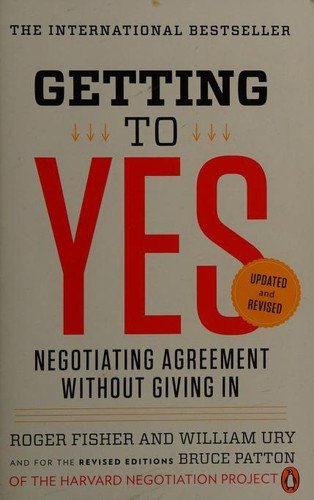
Getting to Yes
Negotiating Agreement Without Giving In
Separate people from the problem and focus on interests, not positions. The classic of principled negotiation.
- Published 1981
- Moderate
- Practical guidance
- 2 min analysis
As an Amazon Associate I earn from qualifying purchases.
Introduction
Roger Fisher and William Ury, later joined by Bruce Patton, developed 'principled negotiation' at the Harvard Negotiation Project. Getting to Yes, first published in 1981, became one of the most influential negotiation books ever.
It offers a method for reaching agreements that are wise, efficient and preserve relationships.
Who should read this book?
Anyone who negotiates: managers, lawyers, diplomats, couples and parents.
Helps with: Communicate and persuade, Lead and grow at work
The central message
Negotiate on the merits: separate people from the problem, focus on interests, invent options for mutual gain and use objective criteria.
Key ideas and concepts
Separate the people from the problem
Deal with relationship issues, like emotions and perceptions, separately from the substance of the negotiation.
Focus on interests, not positions
Positions are what people say they want; interests are why they want it. Interests are easier to reconcile.
Invent options for mutual gain
Brainstorm creative solutions before deciding, rather than fighting over a fixed pie.
Insist on objective criteria
Base agreements on fair standards such as market value, precedent or expert opinion.
Know your BATNA
Your Best Alternative To a Negotiated Agreement determines your power and when to walk away.
Deeper analysis
Getting to Yes is a foundational negotiation book with a clear, practical method. Concepts like interests versus positions and BATNA have become standard vocabulary in business, law and diplomacy, and the approach helps people reach agreements that preserve relationships.
Some argue it underestimates emotions and hardball tactics, a critique Chris Voss makes in Never Split the Difference, and some examples are dated. It assumes a degree of rationality not always present. Still, it's essential reading and works well alongside more emotion-focused approaches.
Practical applications
- Identify interests behind positions.
- Brainstorm options for mutual gain.
- Know your BATNA.
- Use objective criteria.
- Separate people from problems.
Your 7-day action plan
- Day 1
Learn the four principles of principled negotiation.
- Day 2
Pick a current disagreement and list each side's positions.
- Day 3
Identify the interests behind those positions.
- Day 4
Brainstorm at least five options for mutual gain.
- Day 5
Find an objective standard that could guide a fair agreement.
- Day 6
Work out your BATNA and theirs.
- Day 7
Use what you prepared in a real conversation and reflect on it.
Outcomes to expect
What readers who apply this book can realistically take away from it:
- Principled negotiation skills
- Better, fairer agreements
- Preserved relationships
- A clear sense of your alternatives
Strengths and limitations
Strengths
- Foundational, widely used method
- Valuable concepts like BATNA and interests
- Preserves relationships
- Applies to business, law and daily life
Limitations
- Underestimates emotions according to critics
- Some examples dated
- Less helpful against hardball tactics
Reflection questions
- What are the interests behind positions?
- What's your BATNA?
- What options could benefit both?
- What criteria are fair?
Related books
How to Win Friends and Influence People
Dale Carnegie
The classic guide to getting along with people, still useful nearly a century later.


About the authors
Explore the book
Read reviews, see formats (print, Kindle, audiobook) and check the current price.
See it on AmazonAs an Amazon Associate I earn from qualifying purchases.
Book details (title, author, year) are factual. Everything under the headings above is MindsetProdigy's own editorial analysis and interpretation, written to help you decide whether to read the book and how to apply it. It is not a substitute for reading the book itself. Last updated September 28, 2026.