
Recommended
Predictably Irrational
The Hidden Forces That Shape Our Decisions
We're not just irrational; we're irrational in predictable ways. A tour of the quirks behind everyday decisions.
- Published 2008
- Easy read
- Science and research
- 1 min analysis
As an Amazon Associate I earn from qualifying purchases.
Introduction
Dan Ariely, a professor of psychology and behavioural economics at Duke University, became widely known through Predictably Irrational, published in 2008. Through experiments, he shows how relativity, free offers, social norms and expectations push our decisions in predictable directions.
The book helped bring behavioural economics to a mass audience.
Who should read this book?
Curious readers who want an entertaining introduction to behavioural economics and why we make the choices we do.
Helps with: Think and decide more clearly
The central message
Our irrational decisions follow patterns. Understanding them helps us make better choices and design better systems.
Key ideas and concepts
Relativity
We judge things by comparison, so a decoy option can steer our choices.
The power of free
A free offer can make us choose something we wouldn't otherwise.
Social vs market norms
Introducing money can change relationships and motivation.
Expectations
What we expect affects what we experience, as with pricier medicine seeming more effective.
Ownership
We overvalue what we own.
Deeper analysis
Predictably Irrational is entertaining and accessible, with memorable experiments that make behavioural economics stick. It's a good introduction for readers new to the topic.
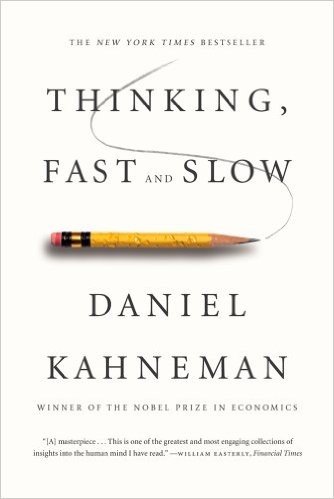
However, some research associated with Ariely has come under serious scrutiny; notably, a 2012 study he co-authored on honesty was retracted in 2021 after data problems were found, though that study isn't the basis of this book. Readers should treat individual findings with caution and look to the broader research. Thinking, Fast and Slow offers a more rigorous foundation.
Practical applications
- Notice decoy options when shopping.
- Pause before choosing something just because it's free.
- Think about whether money is changing a relationship.
- Question how expectations shape your experiences.
- Before selling, ask whether you overvalue what you own.
Your 7-day action plan
- Day 1
Spot a decoy price.
- Day 2
Notice a 'free' offer and its pull.
- Day 3
Reflect on social vs market norms.
- Day 4
Test an expectation.
- Day 5
Notice ownership bias.
- Day 6
Discuss a bias with a friend.
- Day 7
Write the bias you most want to watch.
Outcomes to expect
What readers who apply this book can realistically take away from it:
- Awareness of common decision quirks
- Better shopping decisions
- Understanding of how incentives work
- Healthier scepticism
Strengths and limitations
Strengths
- Entertaining and accessible
- Memorable experiments
- Good introduction to behavioural economics
- Practical relevance
Limitations
- Some research linked to the author has faced scrutiny
- Individual findings should be treated cautiously
- Less rigorous than academic sources
Reflection questions
- When have decoys influenced you?
- How does 'free' change your choices?
- Where do money and relationships mix?
- Which expectations shape your experience?
Related books
Mindset
Carol S. Dweck
Believing you can grow is the first step to actually growing. The landmark book on fixed versus growth…

About the author
Explore the book
Read reviews, see formats (print, Kindle, audiobook) and check the current price.
See it on AmazonAs an Amazon Associate I earn from qualifying purchases.
Book details (title, author, year) are factual. Everything under the headings above is MindsetProdigy's own editorial analysis and interpretation, written to help you decide whether to read the book and how to apply it. It is not a substitute for reading the book itself. Last updated September 30, 2026.