
Essential read
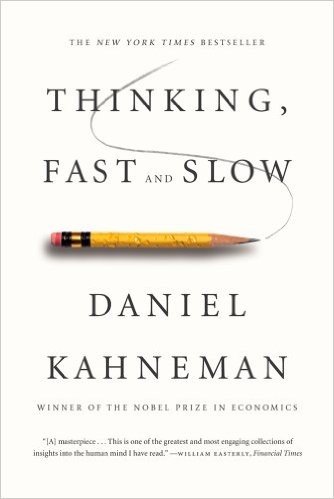
Thinking, Fast and Slow
Meet the two systems in your head: the fast, intuitive one and the slow, deliberate one. Learn when to trust each.
- Published 2011
- Demanding
- Science and research
- 2 min analysis
As an Amazon Associate I earn from qualifying purchases.
Introduction
Daniel Kahneman, a psychologist who received the Nobel Memorial Prize in Economic Sciences in 2002, summarizes decades of research, much of it with his collaborator Amos Tversky, on how people make judgements and decisions.
The book describes two modes of thinking: System 1, which is fast, intuitive and automatic, and System 2, which is slow, deliberate and effortful. Most of our errors come from trusting System 1 when we shouldn't.
Who should read this book?
Curious readers who want to understand the mind, and professionals in business, finance, medicine, law or policy who make important decisions. It's dense, so it suits patient readers.
Helps with: Think and decide more clearly
The central message
Our intuitive mind is fast and useful but prone to predictable errors. Knowing these biases helps us slow down when it matters.
Key ideas and concepts
System 1 and System 2
System 1 jumps to conclusions effortlessly; System 2 checks and calculates but is lazy and easily tired.
Heuristics and biases
Mental shortcuts like anchoring, availability and representativeness lead to systematic mistakes.
Loss aversion
Losses feel roughly twice as painful as equivalent gains feel good, shaping risky choices.
Overconfidence
We trust stories that feel coherent and overestimate how much we know.
Two selves
The experiencing self lives through events; the remembering self judges them, often by peaks and endings.
Deeper analysis
Thinking, Fast and Slow is one of the most influential books on human judgement. It brings together a lifetime of research and explains it with memorable experiments. Readers come away noticing biases everywhere, from shopping to business decisions.
It's long and demanding, and some chapters are heavy going. Since publication, a number of studies in one area it discusses, social priming, have failed to replicate, and Kahneman himself acknowledged he had relied too heavily on that research. The core work on heuristics, biases and prospect theory remains well established. It's more a book for understanding than a self-help manual, though its lessons are widely useful.
Practical applications
- Before big decisions, ask what evidence would change your mind.
- Watch for anchors, such as the first number in a negotiation.
- Imagine a project has failed and list why (a premortem).
- Sleep on decisions made under emotion.
- Ask for an outside view: how did similar projects turn out?
Your 7-day action plan
- Day 1
Notice one quick judgement you made today.
- Day 2
Spot an anchor in a price or negotiation.
- Day 3
Run a premortem on a current plan.
- Day 4
Look for base rates before predicting an outcome.
- Day 5
Notice when you feel overconfident.
- Day 6
Reflect on a memory and its peak and end.
- Day 7
Write down three biases you most want to watch for.
Outcomes to expect
What readers who apply this book can realistically take away from it:
- Awareness of common thinking errors
- Better habits for important decisions
- Understanding of loss aversion and risk
- Humility about intuition
Strengths and limitations
Strengths
- Landmark research explained by its pioneer
- Memorable experiments
- Wide relevance
- Deep and thorough
Limitations
- Long and demanding
- Some priming research has not replicated
- More explanation than practical guidance
Reflection questions
- When does your intuition serve you well, and when does it fail?
- Which bias do you recognize most in yourself?
- How do you make big decisions now?
- How could you add a check to your next important choice?
Related books
Mindset
Carol S. Dweck
Believing you can grow is the first step to actually growing. The landmark book on fixed versus growth…


About the author
Explore the book
Read reviews, see formats (print, Kindle, audiobook) and check the current price.
See it on AmazonAs an Amazon Associate I earn from qualifying purchases.
Book details (title, author, year) are factual. Everything under the headings above is MindsetProdigy's own editorial analysis and interpretation, written to help you decide whether to read the book and how to apply it. It is not a substitute for reading the book itself. Last updated September 27, 2026.