
Essential read
The Mom Test
How to Talk to Customers & Learn If Your Business Is a Good Idea When Everyone Is Lying to You
Everyone, even your mom, will say your idea is great. How to ask questions that reveal the truth.
- Published 2013
- Easy read
- Practical guidance
- 1 min analysis
As an Amazon Associate I earn from qualifying purchases.
Introduction
Rob Fitzpatrick, a startup founder, wrote The Mom Test in 2013 after learning that customer conversations often produce misleading compliments. The title refers to asking questions even your mom couldn't lie to you about.
The short book has become a standard recommendation for founders.
Who should read this book?
Founders, product managers, freelancers and anyone testing an idea with customers.
Helps with: Communicate and persuade, Start something of my own
The central message
Ask about customers' lives and past behaviour, not your idea. Specific facts reveal the truth; compliments and hypotheticals mislead.
Key ideas and concepts
The Mom Test
Talk about their life, not your idea; ask about specifics in the past; talk less and listen more.
Compliments are noise
Praise feels good but tells you little.
Fluff
Hypothetical statements like 'I would buy that' are unreliable.
Commitment and advancement
Real interest shows through time, money or reputation committed.
Keep it casual
Conversations work better without formal 'interviews'.
Deeper analysis
The Mom Test is short, practical and immediately useful. It saves founders from building products nobody wants, and its question examples are easy to adapt.
It focuses on early-stage startups and B2B examples, and it doesn't cover quantitative validation. But for learning from conversations, it's essential.
Practical applications
- Ask a potential customer about the last time they faced the problem.
- Avoid mentioning your idea early.
- Ignore compliments; ask for specifics.
- Ask for a commitment, like a pre-order or meeting.
- Take notes after each conversation.
Your 7-day action plan
- Day 1
Write questions about customers' lives.
- Day 2
Have one conversation.
- Day 3
Ask about past behaviour.
- Day 4
Note compliments vs facts.
- Day 5
Ask for a commitment.
- Day 6
Review notes.
- Day 7
Decide what to change.
Outcomes to expect
What readers who apply this book can realistically take away from it:
- Better customer conversations
- Honest feedback
- Validated or rejected ideas
- Less wasted effort
Strengths and limitations
Strengths
- Short and practical
- Immediately useful
- Clear examples
- Saves wasted effort
Limitations
- Focused on early startups
- B2B examples
- No quantitative validation
Reflection questions
- What did customers do last time they had this problem?
- Are you hearing compliments or facts?
- What commitment could you ask for?
- What would prove your idea wrong?
Related books
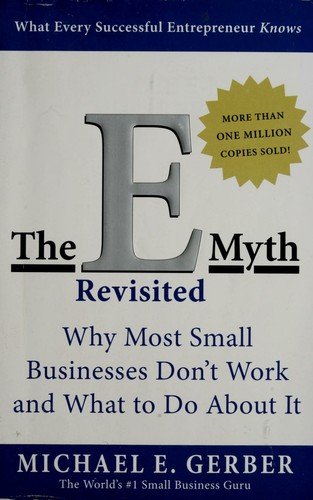
The E-Myth Revisited
Michael E. Gerber
Work on your business, not just in it. Why small businesses struggle, and how systems set you free.

About the author
Explore the book
Read reviews, see formats (print, Kindle, audiobook) and check the current price.
See it on AmazonAs an Amazon Associate I earn from qualifying purchases.
Book details (title, author, year) are factual. Everything under the headings above is MindsetProdigy's own editorial analysis and interpretation, written to help you decide whether to read the book and how to apply it. It is not a substitute for reading the book itself. Last updated October 1, 2026.