Essential read
The Innovator's Dilemma
When New Technologies Cause Great Firms to Fail
Why well-run companies fail when new technologies arrive, and the theory of disruptive innovation.
- Published 1997
- Demanding
- Science and research
- 1 min analysis
As an Amazon Associate I earn from qualifying purchases.
Introduction
Clayton M. Christensen was a professor at Harvard Business School. The Innovator's Dilemma, published in 1997, introduced the theory of 'disruptive innovation', one of the most influential business ideas of recent decades.
Studying industries like disk drives, he showed that successful companies can fail precisely because they do the 'right' things: listening to their best customers and investing in higher-margin products.
Who should read this book?
Entrepreneurs, managers, investors and anyone interested in how industries change.
Helps with: Start something of my own, Think and decide more clearly
The central message
Disruptive technologies often start as worse, cheaper products for overlooked customers. Leaders ignore them because good management tells them to, until it's too late.
Key ideas and concepts
Sustaining vs disruptive innovation
Sustaining innovations improve products for existing customers; disruptive ones start simpler and cheaper for new or overlooked markets.
The dilemma
Doing what's rational for current customers and profits can lead established firms to miss disruption.
Low-end footholds
Disruptors often start with customers incumbents don't value.
Separate units
Christensen suggests established firms create independent units to pursue disruptive opportunities.
Value networks
Companies are shaped by the customers and partners they serve.
Deeper analysis
The Innovator's Dilemma is a foundational business book whose concepts are used widely in strategy and startups. It explains why giants stumble and gives entrepreneurs a lens for finding overlooked opportunities.
The book is academic and data-heavy, especially the disk drive chapters. The term 'disruption' has been overused, and some scholars have questioned how well the theory predicts outcomes. Still, its core insight remains powerful.
Practical applications
- Identify customers your industry overlooks.
- Ask whether a cheaper, simpler product could serve them.
- Watch new entrants that seem 'not good enough' yet.
- Consider separate experiments for new ideas.
- Reflect on how your best customers might limit you.
Your 7-day action plan
- Day 1
Learn sustaining vs disruptive innovation.
- Day 2
Map your industry's customers.
- Day 3
Identify overlooked segments.
- Day 4
Study a potential disruptor.
- Day 5
Brainstorm a simpler offering.
- Day 6
Consider a small experiment.
- Day 7
Reflect on your strategy.
Outcomes to expect
What readers who apply this book can realistically take away from it:
- Understanding of disruption
- Better strategic awareness
- Ideas for overlooked markets
- Clearer view of competitive threats
Strengths and limitations
Strengths
- Foundational, influential theory
- Well researched
- Useful for entrepreneurs and incumbents
- Clear core insight
Limitations
- Academic and data-heavy
- Term 'disruption' overused
- Predictive power debated
Reflection questions
- Who does your industry overlook?
- What 'worse' product could threaten you?
- Are your best customers limiting you?
- Where could you experiment?
Related books
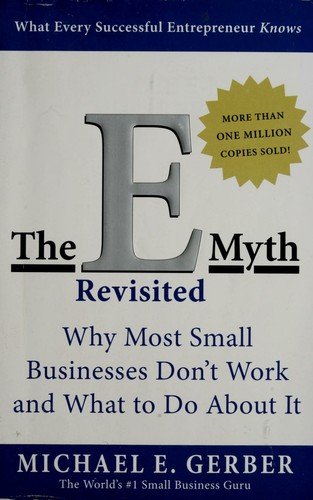
The E-Myth Revisited
Michael E. Gerber
Work on your business, not just in it. Why small businesses struggle, and how systems set you free.
About the author
Explore the book
Read reviews, see formats (print, Kindle, audiobook) and check the current price.
See it on AmazonAs an Amazon Associate I earn from qualifying purchases.
Book details (title, author, year) are factual. Everything under the headings above is MindsetProdigy's own editorial analysis and interpretation, written to help you decide whether to read the book and how to apply it. It is not a substitute for reading the book itself. Last updated September 30, 2026.