
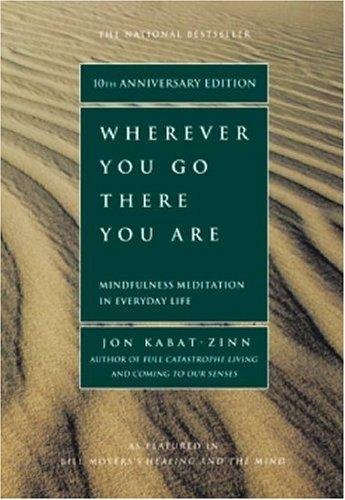
Highly recommended
Wherever You Go, There You Are
Mindfulness Meditation in Everyday Life
Short reflections on bringing mindfulness into everyday life, from the founder of MBSR.
- Published 1994
- Easy read
- Philosophy and ideas
- 2 min analysis
As an Amazon Associate I earn from qualifying purchases.
Introduction
Jon Kabat-Zinn founded the Stress Reduction Clinic at the University of Massachusetts Medical School in 1979, where he developed Mindfulness-Based Stress Reduction (MBSR), now one of the most studied mindfulness programmes. Wherever You Go, There You Are, published in 1994, is a short, gentle introduction to mindfulness in everyday life.
The book is made of brief chapters, each exploring an aspect of practice, from patience to non-doing.
Who should read this book?
Beginners curious about mindfulness, busy people who want calm, and readers who prefer short, reflective chapters.
Helps with: Calm stress and anxiety
The central message
Mindfulness means paying attention, on purpose, in the present moment, without judgement. It can be practised anywhere, in ordinary moments.
Key ideas and concepts
A definition of mindfulness
Kabat-Zinn's widely quoted definition: paying attention in a particular way, on purpose, in the present moment, and non-judgementally.
Formal and informal practice
Mindfulness includes dedicated meditation and bringing awareness to everyday activities.
Non-doing
Allowing things to be as they are, rather than constantly striving to change them.
Patience and letting go
Mindfulness cultivates patience and the ability to release thoughts and feelings.
You can't escape yourself
The title's point: changing circumstances won't bring peace if you bring the same mind with you.
Deeper analysis
Wherever You Go, There You Are is a gentle, accessible classic. Its short chapters, each a few pages, are easy to read in small doses, and Kabat-Zinn's credibility as the developer of Mindfulness-Based Stress Reduction gives the book weight. Mindfulness practice has substantial research support for reducing stress, and the book captures its spirit well.
It's reflective rather than instructional; beginners wanting step-by-step guidance may prefer an MBSR course or app alongside it. Some chapters feel abstract or poetic. Still, it's one of the best short introductions to the attitude behind mindfulness.
Practical applications
- Practise five minutes of breathing meditation.
- Do one daily activity mindfully.
- Notice judgements without acting on them.
- Practise patience in a frustrating moment.
- Take a mindful walk.
Your 7-day action plan
- Day 1
Meditate for five minutes.
- Day 2
Eat one meal mindfully.
- Day 3
Walk mindfully.
- Day 4
Notice judgements.
- Day 5
Practise non-doing for ten minutes.
- Day 6
Meditate for ten minutes.
- Day 7
Reflect on your experience.
Outcomes to expect
What readers who apply this book can realistically take away from it:
- A beginner mindfulness practice
- Less reactivity
- More presence in daily life
- Reduced stress
Strengths and limitations
Strengths
- Gentle, accessible classic
- Short chapters easy to read in small doses
- Written by the developer of MBSR
- Captures the spirit of mindfulness well
Limitations
- Reflective rather than step-by-step
- Some chapters abstract
- Beginners may want a structured course
Reflection questions
- When are you most present?
- What would you notice if you slowed down?
- How do you react to frustration?
- Where could you practise mindfulness today?
Related books
Feeling Good
David D. Burns
Change the distorted thoughts behind low moods. The classic self-help guide to cognitive therapy.
The Choice
Edith Eger
An Auschwitz survivor who became a psychologist shares her journey to freedom and healing.


About the author
Explore the book
Read reviews, see formats (print, Kindle, audiobook) and check the current price.
See it on AmazonAs an Amazon Associate I earn from qualifying purchases.
Book details (title, author, year) are factual. Everything under the headings above is MindsetProdigy's own editorial analysis and interpretation, written to help you decide whether to read the book and how to apply it. It is not a substitute for reading the book itself. Last updated September 28, 2026.