
Highly recommended
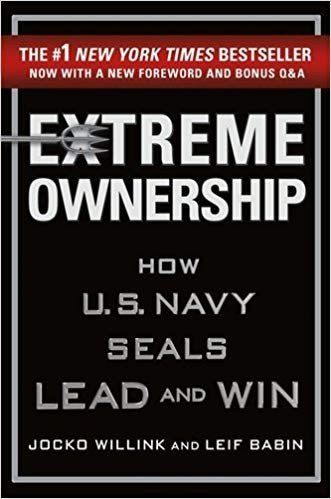
Extreme Ownership
How U.S. Navy SEALs Lead and Win
Own everything in your world, and you'll find the power to change it. Leadership lessons from combat.
- Published 2015
- Easy read
- Stories and memoir
- 2 min analysis
As an Amazon Associate I earn from qualifying purchases.
Introduction
Jocko Willink and Leif Babin are former U.S. Navy SEAL officers who served together in Iraq, including in the Battle of Ramadi. After leaving the military, they founded a leadership consulting firm. Extreme Ownership translates lessons from combat into principles for leaders in business and life.
Each chapter tells a combat story, explains the principle, and then shows how it applies in a business setting.
Who should read this book?
Leaders, managers, team members and anyone who wants to take more responsibility for results. It suits readers who like direct, no-excuses writing.
Helps with: Lead and grow at work, Stay motivated
The central message
Leaders must take complete ownership of everything in their world, including mistakes and failures. When leaders own problems, teams solve them.
Key ideas and concepts
Extreme ownership
Leaders take responsibility for everything that affects the mission, including others' mistakes, instead of blaming.
No bad teams, only bad leaders
Willink and Babin argue that performance reflects leadership, and that changing a leader can transform a team.
Believe in the mission
Leaders must understand and believe in why they're doing something to convince others.
Cover and move
Teams must support each other rather than compete; everyone succeeds or fails together.
Simple, prioritize and execute, decentralized command
Keep plans simple, tackle the most important problem first, and empower junior leaders to make decisions within clear intent.
Deeper analysis
Extreme Ownership is powerful because its central idea is simple and demanding. Taking responsibility, rather than blaming circumstances or others, is one of the most effective ways to improve results, and the combat stories make the lessons vivid. The principles of simplicity, prioritization and decentralized command are practical for any team.
The military context won't appeal to everyone, and some business examples feel generic compared with the war stories. Taken too far, 'extreme ownership' can encourage leaders to shoulder blame for systemic problems they cannot fix, or to tolerate overwork. The book also says little about emotional or interpersonal aspects of leadership. As a framework for accountability and clear leadership, it is excellent.
Practical applications
- After a setback, list what you could have done differently as a leader.
- Explain the 'why' of a project to your team.
- Simplify a complicated plan.
- Prioritize your team's most urgent problem and focus on it first.
- Give a team member authority to make a decision within clear guidelines.
Your 7-day action plan
- Day 1
Take ownership of one recent problem.
- Day 2
Explain the mission behind a current task.
- Day 3
Simplify one plan or process.
- Day 4
Prioritize and execute on the top issue.
- Day 5
Support another team rather than competing.
- Day 6
Delegate a decision with clear intent.
- Day 7
Debrief the week and identify lessons.
Outcomes to expect
What readers who apply this book can realistically take away from it:
- A no-excuses mindset
- Stronger accountability in teams
- Simpler plans and clearer priorities
- Empowered team members
Strengths and limitations
Strengths
- Clear, demanding central principle
- Vivid combat stories
- Practical leadership principles
- Applies to work and personal life
Limitations
- Military context won't suit everyone
- Business examples feel generic
- Ownership taken too far can ignore systemic problems
Reflection questions
- What problem are you blaming on others?
- Does your team understand why they're doing their work?
- Where could you simplify?
- How could you give others more ownership?
Related books
How to Win Friends and Influence People
Dale Carnegie
The classic guide to getting along with people, still useful nearly a century later.
The 7 Habits of Highly Effective People
Stephen R. Covey
Seven principles for leading yourself first, then working well with others. One of the most influential…


Part of the reading paths: Become a Better Leader, Build Unbreakable Discipline
About the authors
Explore the book
Read reviews, see formats (print, Kindle, audiobook) and check the current price.
See it on AmazonAs an Amazon Associate I earn from qualifying purchases.
Book details (title, author, year) are factual. Everything under the headings above is MindsetProdigy's own editorial analysis and interpretation, written to help you decide whether to read the book and how to apply it. It is not a substitute for reading the book itself. Last updated September 27, 2026.