
Highly recommended
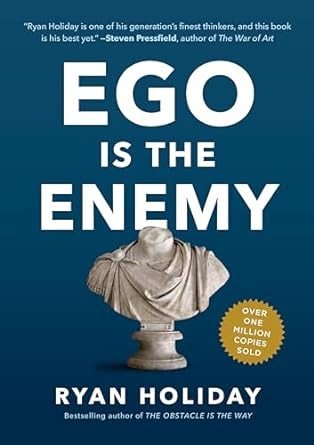
Ego Is the Enemy
The biggest threat to your success may be your own ego. Humility for ambitious people.
- Published 2016
- Easy read
- Philosophy and ideas
- 2 min analysis
As an Amazon Associate I earn from qualifying purchases.
Introduction
Ryan Holiday, a writer on Stoic philosophy, argues that ego, an unhealthy belief in our own importance, is the obstacle to success, the danger once we achieve it, and the thing that makes failure worse.
Drawing on history and Stoic thought, Ego Is the Enemy is structured in three parts: aspire, success and failure.
Who should read this book?
Ambitious people, leaders, creatives and anyone who wants to stay humble and grounded while pursuing goals.
Helps with: Bounce back from setbacks, Lead and grow at work
The central message
Ego sabotages us at every stage of life. Humility, discipline and focus on the work help us aspire, succeed and recover from failure.
Key ideas and concepts
Aspire: talk less, do more
When starting out, ego tempts us to talk about goals instead of working on them. Stay a student and let the work speak.
The canvas strategy
Help others succeed by clearing the path for them, which builds skills, relationships and humility.
Success: stay humble
After success, ego breeds entitlement and complacency. Keep learning and remember what got you there.
Failure: own it
When we fail, ego makes us blame others. Accept responsibility and learn.
Restraint and self-control
Resist the need for recognition and focus on what you can control.
Deeper analysis
Ego Is the Enemy is a useful reminder for ambitious people. Holiday's three-part structure, aspire, success and failure, shows how ego causes trouble at every stage, and historical examples from figures like Ulysses S. Grant, Howard Hughes and Katharine Graham make the lessons memorable. It's a welcome antidote to self-promotion culture.
The book repeats its main point and relies on selective historical anecdotes. It doesn't clearly distinguish unhealthy ego from healthy confidence and self-respect, which some readers, especially those who already struggle with self-doubt, need. Still, it's an effective corrective for anyone chasing recognition.
Practical applications
- Spend more time doing than talking about goals.
- Help someone else succeed this week.
- After a success, write what you still need to learn.
- After a setback, focus on what you can learn.
- Avoid seeking recognition for a good deed.
Your 7-day action plan
- Day 1
Notice three moments where ego shows up in your thoughts or speech.
- Day 2
Work on a goal for an hour without telling anyone about it.
- Day 3
Help someone else succeed using the canvas strategy.
- Day 4
Write what you still need to learn after a past success.
- Day 5
Write what you learned from a past failure, without blaming anyone.
- Day 6
Do one good deed without seeking credit for it.
- Day 7
Reflect on where humility would most improve your life.
Outcomes to expect
What readers who apply this book can realistically take away from it:
- Greater humility
- Focus on work rather than image
- Better response to success and failure
- Healthier, steadier ambition
Strengths and limitations
Strengths
- Useful reminder for ambitious people
- Clear three-part structure
- Memorable historical examples
- Antidote to self-promotion culture
Limitations
- Repeats its main point
- Selective historical anecdotes
- Blurs unhealthy ego and healthy confidence
Reflection questions
- Where does your ego get in the way?
- Do you talk more than you do?
- How do you respond to success?
- Who could you help succeed?
Related books
Atomic Habits
James Clear
Small changes, repeated daily, add up to a life that looks completely different. A clear, practical system…
Man's Search for Meaning
Viktor E. Frankl
Even in the worst conditions, we can choose our attitude and find meaning. One of the most influential books…


About the author
Explore the book
Read reviews, see formats (print, Kindle, audiobook) and check the current price.
See it on AmazonAs an Amazon Associate I earn from qualifying purchases.
Book details (title, author, year) are factual. Everything under the headings above is MindsetProdigy's own editorial analysis and interpretation, written to help you decide whether to read the book and how to apply it. It is not a substitute for reading the book itself. Last updated September 27, 2026.