
Recommended
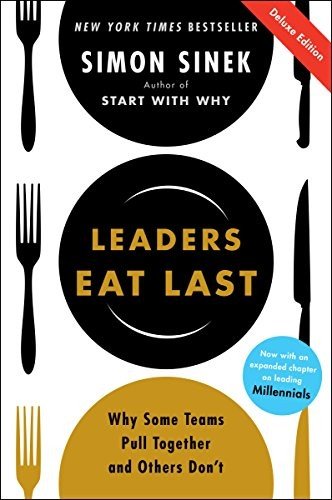
Leaders Eat Last
Why Some Teams Pull Together and Others Don't
Great leaders make people feel safe, and teams thrive because of it.
- Published 2014
- Easy read
- Stories and memoir
- 2 min analysis
As an Amazon Associate I earn from qualifying purchases.
Introduction
In Leaders Eat Last, Simon Sinek explores why some teams pull together while others fall apart. The title comes from a practice in the U.S. Marine Corps, where officers eat after their troops.
Sinek argues that great leaders create a 'circle of safety', an environment where people feel protected and trust one another, so they can focus on outside challenges rather than internal threats.
Who should read this book?
Managers, team leaders, executives and anyone who wants to build a trusting workplace culture.
Helps with: Lead and grow at work
The central message
Leadership is about putting the welfare of others first. When leaders create safety and trust, people cooperate and perform at their best.
Key ideas and concepts
The circle of safety
When people feel safe inside an organization, they work together against external threats rather than competing with each other.
Biology of trust
Sinek links behaviour to chemicals like endorphins, dopamine, serotonin and oxytocin, suggesting good leadership encourages those linked to trust and cooperation.
Abstraction
When leaders see people as numbers, they make decisions that harm them, such as layoffs to meet short-term targets.
Leadership as sacrifice
True leaders give up their own interests to protect their people.
Generational influences
Sinek discusses how economic and cultural shifts have affected workplace trust.
Deeper analysis
Leaders Eat Last makes a compelling case for people-first leadership. Sinek's stories of leaders who protected their people, including companies that refused layoffs during downturns, are moving, and his 'circle of safety', an environment where people trust each other and feel protected, aligns with research on psychological safety in teams. The title, drawn from a U.S. Marine Corps practice, is a memorable symbol.
The brain chemistry explanations, linking leadership to endorphins, dopamine, serotonin and oxytocin, are heavily simplified, and some readers find the generalizations about generations unconvincing. Like Start With Why, it repeats its key ideas. Its message is valuable, but the science should be taken with caution.
Practical applications
- Ask your team what makes them feel unsafe at work.
- Share credit and take blame as a leader.
- Spend time with team members without an agenda.
- Avoid treating people as numbers in decisions.
- Protect someone from unfair pressure.
Your 7-day action plan
- Day 1
Reflect on whether your team feels safe.
- Day 2
Ask one team member how you can support them.
- Day 3
Share credit publicly.
- Day 4
Take responsibility for a mistake.
- Day 5
Spend unstructured time with your team.
- Day 6
Review a decision for its human impact.
- Day 7
Plan one change to increase safety.
Outcomes to expect
What readers who apply this book can realistically take away from it:
- Greater trust within teams
- A more cooperative culture
- People-first decision making
- Stronger loyalty and engagement
Strengths and limitations
Strengths
- Compelling case for people-first leadership
- Memorable stories and examples
- Circle of safety matches research on psychological safety
- Inspiring message for managers
Limitations
- Simplified brain chemistry
- Unconvincing generalizations about generations
- Repeats key ideas
Reflection questions
- Does your team feel safe with you?
- When did a leader sacrifice for you?
- Do you see people as numbers?
- How could you put your team first?
Related books
How to Win Friends and Influence People
Dale Carnegie
The classic guide to getting along with people, still useful nearly a century later.
The 7 Habits of Highly Effective People
Stephen R. Covey
Seven principles for leading yourself first, then working well with others. One of the most influential…


About the author
Explore the book
Read reviews, see formats (print, Kindle, audiobook) and check the current price.
See it on AmazonAs an Amazon Associate I earn from qualifying purchases.
Book details (title, author, year) are factual. Everything under the headings above is MindsetProdigy's own editorial analysis and interpretation, written to help you decide whether to read the book and how to apply it. It is not a substitute for reading the book itself. Last updated September 27, 2026.