
Highly recommended
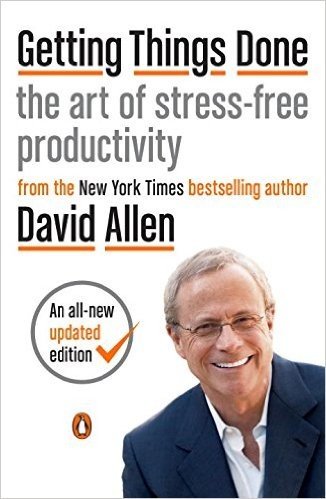
Getting Things Done
The Art of Stress-Free Productivity
Get everything out of your head and into a trusted system, so your mind can focus on doing instead of remembering.
- Published 2001
- Moderate
- Practical guidance
- 2 min analysis
As an Amazon Associate I earn from qualifying purchases.
Introduction
David Allen's Getting Things Done, first published in 2001 and revised in 2015, introduced a complete system for managing work and life. Allen argues that our minds are for having ideas, not holding them. When every commitment is stored in a trusted system outside your head, you can focus with what he calls a 'mind like water'.
The method, known as GTD, has a devoted following among professionals worldwide.
Who should read this book?
People with lots of tasks, projects and responsibilities who feel overwhelmed or keep forgetting things. It suits managers, freelancers, parents and anyone with many open loops.
Helps with: Calm stress and anxiety, Focus and get more done
The central message
Capture everything that has your attention, decide what it means and what to do next, and keep it organized in a trusted system you review every week.
Key ideas and concepts
Capture
Collect every task, idea and commitment into a small number of inboxes so nothing stays only in your head.
Clarify
Process each item: Is it actionable? If it takes less than two minutes, do it now. Otherwise delegate it or define the very next physical action.
Organize
Keep lists for next actions, projects, waiting-for items and someday/maybe ideas, and put time-specific items on a calendar.
Reflect
The weekly review is the heart of the system: update all lists, clear inboxes and look ahead.
Engage
Choose what to do based on context, time available, energy and priority, trusting your lists.
Deeper analysis
Getting Things Done remains one of the most complete and influential productivity systems. Its insistence on defining the very next physical action turns vague worries into doable tasks, and the weekly review provides a reliable way to stay on top of commitments. Many readers describe a real reduction in mental clutter once their lists are complete.
The system is detailed and takes effort to set up and maintain, and some readers abandon it under the weight of lists. It also focuses on managing everything rather than on deciding what matters most, which is why it pairs well with books like Essentialism. Some examples, especially in the original edition, feel tied to paper-based office life, though the 2015 revision updates them. For people drowning in commitments, it is still a strong foundation.
Practical applications
- Do a full mind sweep: write down everything on your mind.
- Process your inbox using the two-minute rule.
- Write the next physical action for each active project.
- Create a 'waiting for' list for things others owe you.
- Schedule a weekly review every Friday afternoon.
Your 7-day action plan
- Day 1
Do a full mind sweep onto paper.
- Day 2
Set up your inbox and lists.
- Day 3
Process everything using the two-minute rule.
- Day 4
Write the next action for each project.
- Day 5
Create a someday/maybe list.
- Day 6
Use your lists to choose what to work on.
- Day 7
Do your first weekly review.
Outcomes to expect
What readers who apply this book can realistically take away from it:
- A trusted system that holds every commitment
- Less mental clutter and stress
- Clear next actions for every project
- A weekly habit of review and planning
- Fewer forgotten tasks and dropped balls
Strengths and limitations
Strengths
- Complete, proven system
- Next-action thinking makes tasks doable
- Weekly review keeps everything current
- Works with any tool, paper or digital
Limitations
- Takes effort to set up and maintain
- Focuses on managing tasks more than choosing what matters
- Some readers find it overly detailed
Reflection questions
- What open loops are taking up space in your mind right now?
- Which of your projects lacks a clear next action?
- When could you schedule a weekly review?
- Do you trust your current system? Why or why not?
Related books
Atomic Habits
James Clear
Small changes, repeated daily, add up to a life that looks completely different. A clear, practical system…
Deep Work
Cal Newport
In a world of constant pings, the ability to focus deeply on hard work is rare and valuable. Here is how to…


Compare: Getting Things Done vs. Essentialism
Part of the reading path: Master Productivity
About the author
Explore the book
Read reviews, see formats (print, Kindle, audiobook) and check the current price.
See it on AmazonAs an Amazon Associate I earn from qualifying purchases.
Book details (title, author, year) are factual. Everything under the headings above is MindsetProdigy's own editorial analysis and interpretation, written to help you decide whether to read the book and how to apply it. It is not a substitute for reading the book itself. Last updated September 26, 2026.