
Essential read
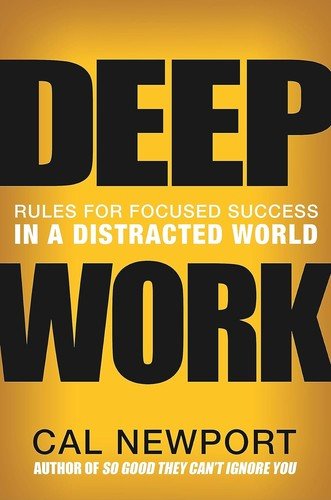
Deep Work
Rules for Focused Success in a Distracted World
In a world of constant pings, the ability to focus deeply on hard work is rare and valuable. Here is how to get it back.
- Published 2016
- Moderate
- Practical guidance
- 2 min analysis
As an Amazon Associate I earn from qualifying purchases.
Introduction
Cal Newport, a computer science professor at Georgetown University, distinguishes between deep work, focused effort on cognitively demanding tasks, and shallow work: email, meetings and the small tasks that fill most days. He argues that deep work is becoming both rarer and more valuable, and that people who can do it will thrive.
The first part of the book makes the case; the second offers four rules for building a deep-work life, from scheduling focus time to quitting social media that doesn't earn its place.
Who should read this book?
Students, writers, programmers, researchers, creators and anyone whose work depends on thinking hard. Also anyone who ends busy days feeling they achieved nothing important.
Helps with: Focus and get more done, Lead and grow at work
The central message
The ability to focus without distraction on demanding work is a rare, valuable skill that can be trained, and building your working life around it produces better results in less time.
Key ideas and concepts
Deep versus shallow work
Deep work creates new value and improves your skills; shallow work is easy to replicate and rarely moves you forward.
Choose a depth philosophy
Options range from monastic (cut off almost entirely) to rhythmic (a fixed daily block) to journalistic (fit deep sessions in wherever possible).
Embrace boredom
If you reach for your phone at every quiet moment, your brain loses the ability to concentrate. Practise being bored.
Quit social media selectively
Keep a tool only if its benefits clearly outweigh its costs for the things you value most.
Drain the shallows
Schedule every minute of the workday, cap shallow work, and become harder to reach.
Deeper analysis
Deep Work arrived at the right moment and gave many people language for a problem they felt but couldn't name. Its rules are concrete, and the idea of treating focus as a skill rather than a personality trait is empowering.
The advice fits people with control over their schedules better than those in roles where responsiveness is the job, such as customer service or many junior positions. Some examples feature famous or unusually privileged workers. Still, even partial adoption, such as one protected focus block a day, can make a noticeable difference.
Practical applications
- Block one to two hours of focus time on your calendar each day and treat it like a meeting.
- Choose a shutdown ritual to end the workday and stop checking email afterwards.
- Batch email and messages into set times instead of checking constantly.
- Practise boredom: wait in line without your phone.
- Evaluate each social app against your most important goals.
Your 7-day action plan
- Day 1
Track how much of your day is deep versus shallow work.
- Day 2
Schedule a 60-minute deep-work block and protect it.
- Day 3
Turn off all notifications during that block.
- Day 4
Create a shutdown ritual for the end of the day.
- Day 5
Batch email into two or three set times.
- Day 6
Spend a phone-free hour doing something that requires concentration.
- Day 7
Review your week and plan next week's deep-work blocks.
Outcomes to expect
What readers who apply this book can realistically take away from it:
- More meaningful work finished in less time
- Greater ability to concentrate for long periods
- A clearer boundary between work and rest
Strengths and limitations
Strengths
- Clear argument and practical rules
- Treats focus as a trainable skill
- Challenges unhelpful workplace norms
Limitations
- Easier to apply with control over your schedule
- Some examples come from unusually privileged careers
- Can feel absolutist about social media
Reflection questions
- What portion of your work is truly deep?
- What would you produce with two undistracted hours a day?
- Which tool costs you more attention than it gives back?
Related books
Atomic Habits
James Clear
Small changes, repeated daily, add up to a life that looks completely different. A clear, practical system…


Compare: Deep Work vs. Digital Minimalism
Part of the reading path: Master Productivity
About the author
Explore the book
Read reviews, see formats (print, Kindle, audiobook) and check the current price.
See it on AmazonAs an Amazon Associate I earn from qualifying purchases.
Book details (title, author, year) are factual. Everything under the headings above is MindsetProdigy's own editorial analysis and interpretation, written to help you decide whether to read the book and how to apply it. It is not a substitute for reading the book itself. Last updated September 26, 2026.