
Recommended
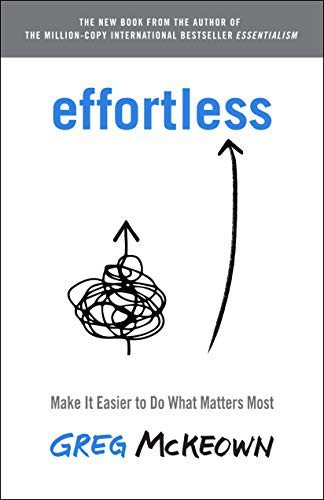
Effortless
Make It Easier to Do What Matters Most
What if the important things didn't have to be so hard? The follow-up to Essentialism on making essential work easier.
- Published 2021
- Easy read
- Practical guidance
- 2 min analysis
As an Amazon Associate I earn from qualifying purchases.
Introduction
Greg McKeown wrote Effortless as a follow-up to Essentialism. Where Essentialism helps you choose what matters, Effortless asks how to make doing those things easier. McKeown argues that we often make important work harder than it needs to be, out of a belief that effort equals value.
The book has three parts: Effortless State, Effortless Action and Effortless Results.
Who should read this book?
Hard-working people who feel exhausted, readers of Essentialism, and anyone who suspects they're overcomplicating things.
Helps with: Calm stress and anxiety, Focus and get more done
The central message
Make the essential easy. Get into a rested, clear state, simplify how you work, and build systems that produce results without constant effort.
Key ideas and concepts
Invert the problem
When something feels hard, ask 'What if this could be easy?' The question often reveals a simpler path.
The effortless state
Rest, gratitude and letting go of grudges clear mental clutter so you can think clearly.
Define what 'done' looks like
Knowing the finish line before you start prevents endless tinkering.
Simplify and start small
Remove unnecessary steps and begin with the minimum viable effort, then build momentum.
Residual results
Invest in things that keep paying off, like learning, systems and automation.
Deeper analysis
Effortless is a useful companion to Essentialism. Where that book helps you choose what matters, this one helps you do it without unnecessary struggle. The question 'What if this could be easy?' is a powerful prompt for people stuck in overwork, and ideas like defining 'done' and building residual results are practical.
Some ideas are familiar from other productivity books, and it feels less original than Essentialism. The title may sound unrealistic for people facing genuinely hard circumstances. Used as a set of prompts for simplifying, it's helpful.
Practical applications
- Ask 'What if this could be easy?' about a hard task.
- Define 'done' before starting a project.
- Remove one unnecessary step from a routine.
- Automate one recurring task.
- Take a real rest before tackling an important project.
Your 7-day action plan
- Day 1
Pick an important task you've been dreading.
- Day 2
Ask how it could be easy.
- Day 3
Define 'done' for it.
- Day 4
Take the first small, simple step.
- Day 5
Remove one unnecessary step.
- Day 6
Set up a system or automation.
- Day 7
Reflect on how it felt.
Outcomes to expect
What readers who apply this book can realistically take away from it:
- Less unnecessary struggle
- Clear definitions of done
- Simpler processes
- Systems that keep producing value
Strengths and limitations
Strengths
- Powerful reframing question
- Practical tips for simplifying work
- Good companion to Essentialism
- Encourages rest before effort
Limitations
- Less original than Essentialism
- Some familiar ideas
- Title may oversell what's possible
Reflection questions
- Where are you making things harder than they need to be?
- What does 'done' look like for your current project?
- Which recurring task could you automate?
- What would happen if you rested before starting?
Related books
Atomic Habits
James Clear
Small changes, repeated daily, add up to a life that looks completely different. A clear, practical system…
Deep Work
Cal Newport
In a world of constant pings, the ability to focus deeply on hard work is rare and valuable. Here is how to…


About the author
Explore the book
Read reviews, see formats (print, Kindle, audiobook) and check the current price.
See it on AmazonAs an Amazon Associate I earn from qualifying purchases.
Book details (title, author, year) are factual. Everything under the headings above is MindsetProdigy's own editorial analysis and interpretation, written to help you decide whether to read the book and how to apply it. It is not a substitute for reading the book itself. Last updated September 26, 2026.