
Recommended
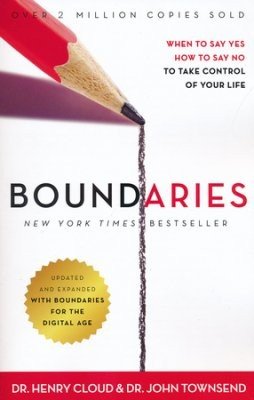
Boundaries
When to Say Yes, How to Say No to Take Control of Your Life
A Christian classic on taking responsibility for your life and setting healthy limits with others.
- Published 1992
- Moderate
- Practical guidance
- 2 min analysis
As an Amazon Associate I earn from qualifying purchases.
Introduction
Henry Cloud and John Townsend are clinical psychologists who wrote Boundaries in 1992 from a Christian perspective. The book helps readers understand where they end and others begin, and how to take responsibility for themselves without taking responsibility for others.
It covers boundaries with family, friends, spouses, children, work, yourself and God.
Who should read this book?
People-pleasers, people who feel responsible for others' feelings, and Christians seeking faith-based guidance on healthy limits.
Helps with: Heal and grow, Improve my relationships
The central message
Healthy boundaries define what is and isn't your responsibility. They protect relationships and allow genuine love.
Key ideas and concepts
Boundaries as property lines
Just as property lines show who owns what, personal boundaries show what you are responsible for: your feelings, attitudes, behaviours, choices and values.
Four boundary problems
Compliants say yes to bad things, avoiders say no to good things, controllers don't respect others' boundaries, and nonresponsives ignore others' needs.
The law of sowing and reaping
People need to experience the natural consequences of their behaviour; rescuing them can prevent growth.
Boundaries enable love
Clear limits make honesty and real love possible, rather than resentment.
Expect resistance
When you set boundaries, others may push back, and you may feel guilt. Both are normal.
Deeper analysis
Boundaries is practical and insightful, giving language to experiences many people struggle to name, such as feeling responsible for everyone's feelings. Its categories of boundary problems are useful for self-reflection, and it covers boundaries with family, friends, spouses, children, work and yourself.
The Christian framing and frequent scripture references won't suit every reader, and the book is long and somewhat repetitive. For readers looking for a secular approach, Set Boundaries, Find Peace covers similar ground. For Christian readers, it remains a classic.
Practical applications
- List areas where you feel responsible for others' feelings.
- Say no to one request this week.
- Let someone experience natural consequences.
- Identify your boundary problem type.
- Communicate one boundary clearly.
Your 7-day action plan
- Day 1
Write down what you are and aren't responsible for in one relationship.
- Day 2
Identify whether you tend to be compliant, avoidant, controlling or nonresponsive.
- Day 3
Notice moments of resentment as signs of a missing boundary.
- Day 4
Say no to one request you would usually accept.
- Day 5
Allow someone to experience the natural consequence of their choice.
- Day 6
Communicate one boundary clearly and kindly.
- Day 7
Reflect on any resistance, from others or yourself.
Outcomes to expect
What readers who apply this book can realistically take away from it:
- Clarity about what you are responsible for
- Ability to say no without excessive guilt
- Healthier relationships
- Less resentment
Strengths and limitations
Strengths
- Practical, insightful and widely influential
- Useful categories of boundary problems
- Covers many types of relationships
- Gives language to common struggles
Limitations
- Christian framing won't suit all readers
- Long and somewhat repetitive
- Secular readers may prefer newer books
Reflection questions
- What are you responsible for?
- Where do you say yes when you mean no?
- Who crosses your boundaries?
- What boundary do you need?
Related books
How to Win Friends and Influence People
Dale Carnegie
The classic guide to getting along with people, still useful nearly a century later.
The Four Agreements
Don Miguel Ruiz
Four simple promises to yourself that can free you from a lot of unhappiness.

About the authors
Explore the book
Read reviews, see formats (print, Kindle, audiobook) and check the current price.
See it on AmazonAs an Amazon Associate I earn from qualifying purchases.
Book details (title, author, year) are factual. Everything under the headings above is MindsetProdigy's own editorial analysis and interpretation, written to help you decide whether to read the book and how to apply it. It is not a substitute for reading the book itself. Last updated September 28, 2026.